
Formula shortage won't end for weeks. I compare every U.S. formula in this chart so you can pivot fast. (Part 1 of 2)
I compared 19 brands so you don't have to. Compare your brand of choice with whatever's at the store now. (Seriously, this took a lot of hours.)

The nationwide formula shortage probably won’t end until late June, when increased production at a major formula manufacturing plant reaches store shelves. Emergency supplies from Europe flown in this week will hopefully help ease the intensity. But U.S. Sec. of Agriculture Tom Vilsack told media it will be “a matter of weeks” until shelves are full again.
Until then, child nutrition experts urge, it’s going to be important to be flexible. That includes switching formulas frequently based on what’s available.
When choosing which formula to switch to, ingredients can lend a clue to help pick the most similar choice.
Let me be clear first: If your child is healthy and your child doesn’t have stomach pain with formula, acid reflux, allergies, or other health issues, any available formula will work for you. (And what you ABSOLUTELY SHOULD NOT DO is make your own, homemade formula. This is dangerous for infants. Please, please, please. Don’t.)
Any formula sold on U.S. shelves will have been rigorously tested and evaluated for appropriate infant growth and vitamin and mineral amounts, said Kelly Green Corkins, a clinical dietitian at LeBonheur Children’s Hospital. All of them will be FDA approved, and thus will be safe and healthy for your child, so save yourself the stress and choose literally whatever is available.
“In healthy term infants, most formulas are fine and you can make the changes to the formulas for signs and symptoms of intolerance which might have slight differences in protein or carbohydrate with no problem,” Green Corkins said. “Don't beat yourself up for not breastfeeding and don't let anyone shame you for not breastfeeding. This is not the time.”
If your child needs a specific type for health reasons — including the infuriating and ill-defined catch-all of “colic” — first speak with your pediatrician and then read on. I’ve created a chart that can help you identify quick alternatives.
First, the practical stuff. Let’s dive into that chart so you can get shopping.
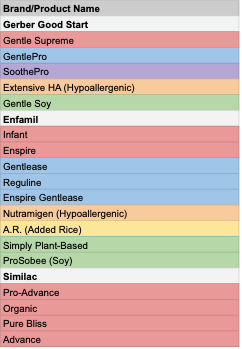
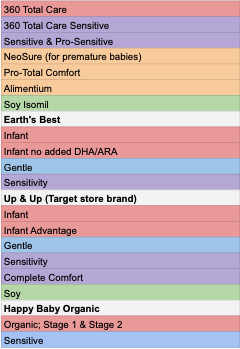
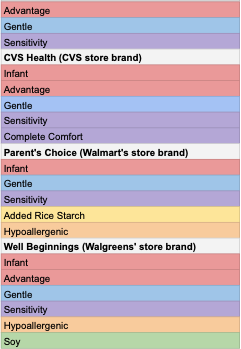
I’ve compiled a list of 19 formula companies and labeled the three important ingredients: carbohydrates, proteins, and fats. The more similar the ingredients, the less likely your child’s stomach will notice a difference from the switch. I’ve provided a color-coded chart that you can use as a way to compare formulas with similar ingredients. I want to find every formula sold in the U.S. Please let me know if I’m missing any and I’ll update this post.
Since there’s no way I can get this behemoth into this phone-sized format, so if you want to see the full chart, here is a link to the full chart in Google Sheets.
For easy access, I’ve grouped them by color based on the formulas that are most similar and the name of the formula will be highlighted based on the ingredients. You should be able to easily switch between any formulas with the same color.



Post continued in part 2/2. Please check your emails or click here!